In this article +
Key takeaways
- 01Rank-tracking data from Applyra shows store-wide Google Play search updates on 14, 16 and 23 September 2026, in nearly every market at once. Google did not announce them.
- 02On 23 September, US results moved 9.6× more than on a normal day; the Netherlands 18×, Germany 17×, India 10.9×. Brazil barely moved (1.9×).
- 03The lower your position, the more it moved: only 7% of US positions in #11–25 and 1.7% in #51–100 kept their exact rank, against 64.6% in the top 3.
- 04Don’t change your listing in a panic. Read your new positions for two or three days, check whether competitors moved too, then act on the keywords that really dropped.
If your Google Play rankings looked strange in the second half of September, you were not imagining it. Rank-tracking data shows three separate search updates between 14 and 23 September, rolled out across most major markets, without a word from Google.
Updates like this are normal. Google adjusts how Play ranks apps all the time, and it rarely says when. What matters is knowing whether your app was affected, and not making it worse with a rushed reaction. Here is what the data shows, and a simple way to check your own app.
What happened, and when
Applyra, an ASO tool that measures how much store search results move every day, published its numbers on 28 September 2026. It compares each market against its own normal level: 1× is an ordinary day, 10× is ten times more movement than usual.
| Date (2026) | Markets affected | United States | Netherlands (highest) |
|---|---|---|---|
| Mon 14 September | 15 | 5.4× | 10.1× |
| Wed 16 September | 14 | 5.9× | 13.1× |
| Wed 23 September | 15 | 9.6× | 18.0× |
It was not the first change of the season either. AppTweak reported detecting a global Google Play search algorithm change on 21 August 2026, with the strongest signals in Japan, South Korea, Germany, Denmark and the US.
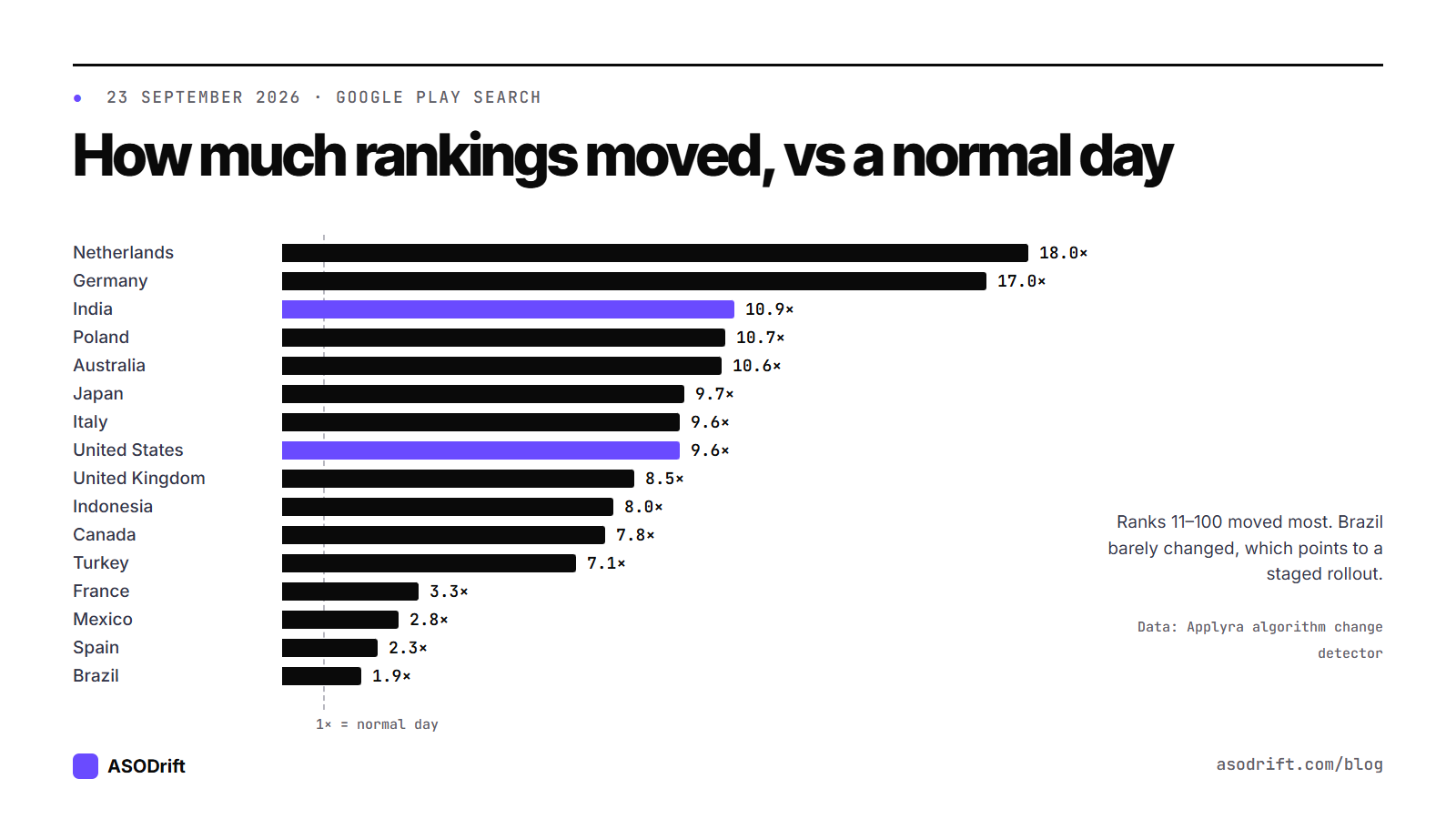
Brazil, Spain, Mexico and France moved far less than the rest, which suggests Google rolled the change out in stages. If your main market is one of those, a delayed wave is possible.
Why apps ranked #11 to #100 felt it most
The top few results for any search were fairly stable. Below them, almost everything moved. According to Applyra’s US figures for 23 September, about two in three apps in the top 3 kept their exact position, but fewer than one in fourteen did in positions 11 to 25.
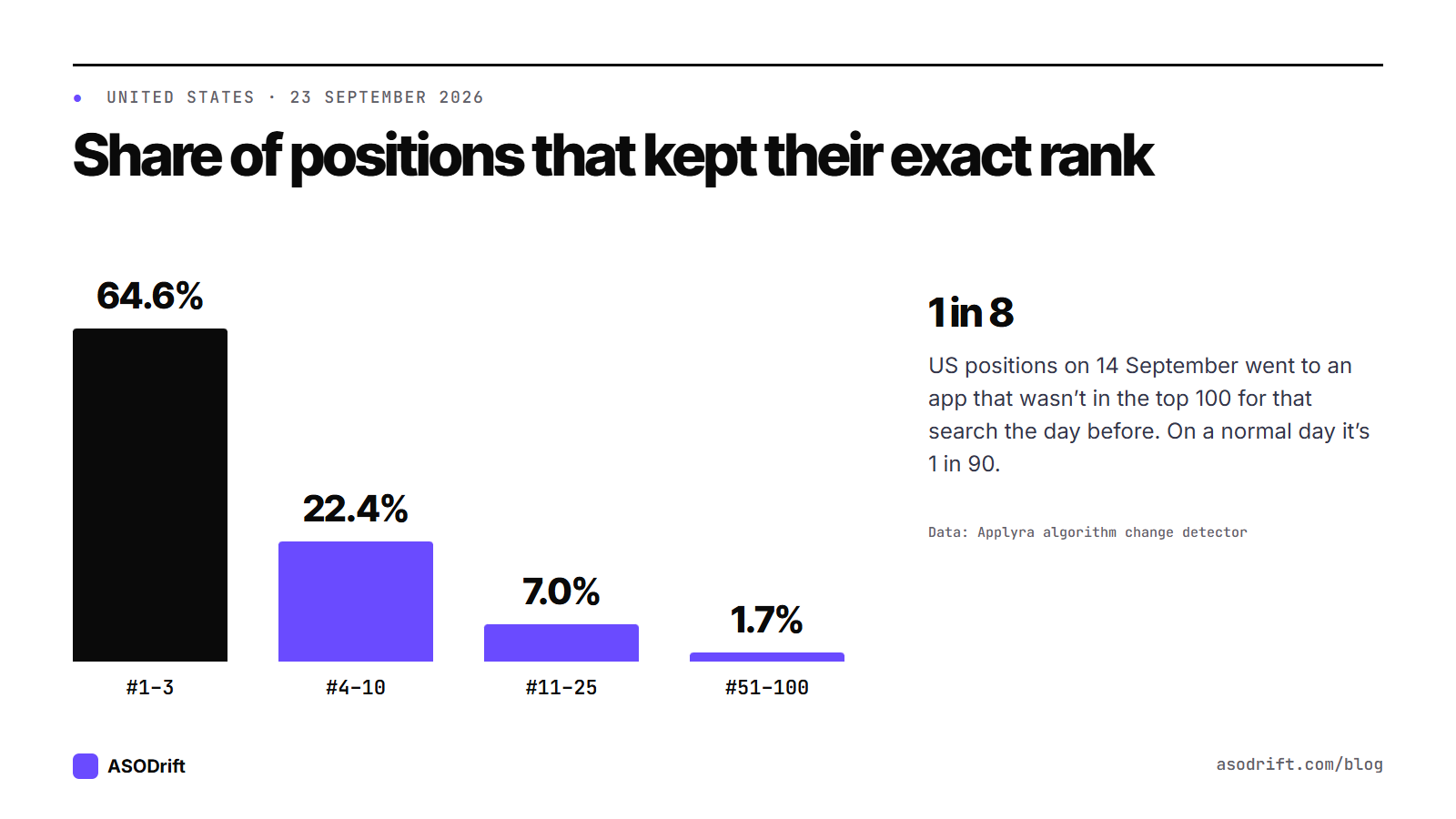
- 1 in 8
- US positions on 14 Sep went to an app not in the top 100 the day before
- 1 in 90
- the same figure on a normal day
- 7%
- of #11–25 positions kept their exact rank on 23 Sep
- 0
- announcements from Google
This is the zone where most smaller and newer apps live, and where a few positions decide whether anyone sees you. Moving from #14 to #9 can mean the difference between being on the first screen of results or not. That is why a quiet ranking update can feel like a sudden drop in installs.
Was your app affected? Check in this order
- Look at your keyword positions for 14, 16 and 23 September. Several keywords moving on the same day points to Google, not to something you did.
- Check whether your competitors moved on the same days. If everyone in your niche shuffled, it was the update.
- Compare countries. If India or the US moved but Brazil did not, that matches the rollout pattern above.
- Rule out your own changes. Did you ship a release, change your title or short description, or get a burst of bad reviews around the same time?
- Look at installs from search in Play Console (Statistics → User acquisition). A ranking drop on a keyword that brings few installs matters much less than one on your main keyword.
What to do (and what not to do)
- +Wait two or three days and read your new positions before changing anything.
- +Focus on the keywords that dropped and actually bring installs.
- +Look at who replaced you, and what their title and short description say that yours don’t.
- +Improve relevance where it is weak: put your most important search phrase in your title or short description.
- +Keep shipping quality: crashes, ratings and reviews affect how Play ranks you.
- −Rewrite your listing the same day out of panic.
- −Change many things at once, so you never know what helped.
- −Judge the update by one keyword in one country.
- −Stuff keywords into your description; Google Play’s metadata policy forbids it.
- −Assume a drop is permanent before the rollout has finished.
Don’t react with a release. A panic metadata change re-triggers indexing at the worst possible moment.Applyra
Make the next update a non-event
Google will change Play search again, probably without telling anyone. The developers who handle it calmly are the ones who notice within a day, can see which keywords and countries moved, and have a record of what their listing looked like before. Then the decision is easy: wait, or fix the few keywords that really matter.
Did Google announce the September 2026 ranking changes?+
No. The updates on 14, 16 and 23 September were detected by rank-tracking tools that measure daily movement in search results. Google Play rarely announces search ranking changes.
Which countries were affected the most?+
On 23 September, Applyra measured the Netherlands at 18.0× normal movement, Germany 17.0×, India 10.9×, Poland 10.7× and Australia 10.6×. The US was at 9.6×. Brazil (1.9×), Spain (2.3×), Mexico (2.8×) and France (3.3×) moved much less.
My ranking dropped in September. Should I change my listing?+
Not straight away. Watch your positions for two or three days, check whether competitors moved too, and only then change the listing for the keywords that dropped and actually bring installs. Change one thing at a time so you can see what worked.
Will rankings go back to how they were?+
Some positions settle back after a rollout finishes, others don’t. Daily rank history for each keyword and country is the only reliable way to see which of your positions recovered.
How do I see my keyword positions on Google Play?+
Play Console shows installs from search, but not your position for each keyword. You need a keyword rank tracker such as ASODrift, which searches Google Play every day and records where your app appears.
Sources
- 01Applyra (via DEV Community): Google Play changed its search rankings 3 times in 10 days, September 2026 (28 Sep 2026)
- 02AppTweak: ASO news and app store updates 2026 (Google Play algorithm change detected 21 August)
Specifications and figures are as published by Google and the listed sources at the time of writing (8 Oct 2026); check Play Console for the latest.